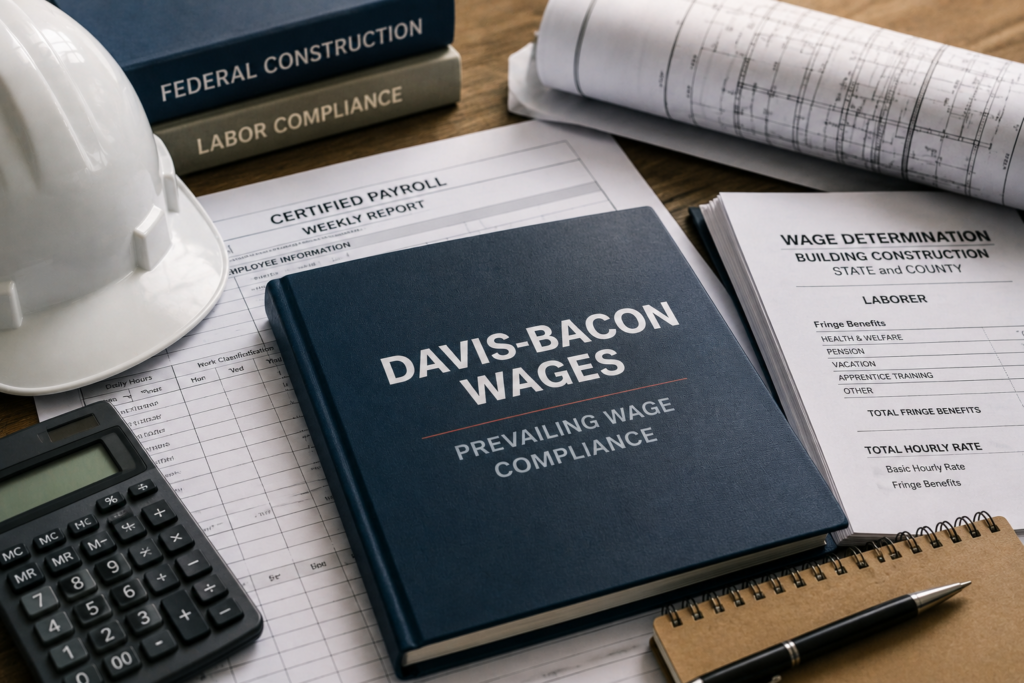
How do Davis-Bacon wages affect the labor costs and profit margin you expected when you bid a federally funded construction project? Understanding Davis-Bacon wages is about much more than finding an hourly wage rate. The requirements can influence how you estimate labor, classify workers, calculate fringe benefits, manage subcontractors, complete certified payroll, and ultimately protect the profitability of your project.
The Davis-Bacon Act generally applies to federal contracts over $2,000 for the construction, alteration, or repair of public buildings and public works. Related federal laws can extend prevailing wage requirements to certain federally assisted projects as well.
For contractors, the operational challenge begins when those requirements move from the contract into the field. A worker performing multiple types of work, an incorrect wage determination, a fringe benefit calculation error, or a subcontractor submitting inaccurate payroll can create costs that were never included in your original estimate.
Understanding the requirements before work begins gives you far more control than correcting payroll after a problem has already affected the project.
If you are preparing for a Davis-Bacon project and want clarity before compliance issues affect your labor costs or margins, book a working session with PWC to identify potential gaps early.
Understanding Davis-Bacon Wage Requirements
The Davis-Bacon Act applies to federal construction contracts exceeding $2,000 for construction, alteration, or repair of public buildings and public works. Approximately 80 Related Acts extend these requirements beyond direct federal contracts to projects that receive federal assistance through grants, loans, or loan guarantees. Examples include the Federal-Aid Highway Acts, Housing and Community Development Act of 1974, and Federal Water Pollution Control Act.
Twenty-eight states have enacted ‘Little Davis Bacon Acts’ that apply prevailing wage standards to state-funded construction projects. The U.S. Department of Labor’s Wage and Hour Division determines prevailing wages and conducts surveys of construction contractors and interested parties. The division publishes wage determinations for four construction categories: building, residential, highway, and heavy.
Wage determinations list the simple hourly rate and fringe benefit amounts for each labor classification in a specific geographic area on a county-by-county basis. Workers must be paid according to the actual duties performed during their workweek, not their job title or normal classification. If someone performs laborer duties for part of the week and equipment operation for another part, those hours must be split and paid at the correct rates for each classification.
How to Calculate and Pay Davis-Bacon Wages Correctly
To calculate Davis-Bacon wage rates, you need to locate the correct wage determination on SAM.gov. This site has served as the single authoritative source for all prevailing wage information since June 14, 2019. You can search by state, county and construction type to download the applicable determination for your project.
Each wage determination specifies two components: the hourly rate and required fringe benefits. Three methods exist to satisfy this obligation. You can pay the entire prevailing wage as cash, provide bona fide fringe benefits that meet or exceed the required amount, or use a combination of both. Bona fide benefits include health insurance and pension plans.
Fringe benefit calculations require annualization. This means you must average the cost across all hours an employee works during the year, not just Davis-Bacon project hours. You must make contributions to fringe benefit plans at least quarterly.
Davis-Bacon projects require weekly payment to workers. You must submit certified payroll reports using Form WH-347 within seven days after each pay date. Each report requires employee names, work classifications, daily and weekly hours, and wage rates, including fringe benefit contributions. Deductions and actual wages paid must also be included. A signed Statement of Compliance must accompany each submission and certify that the information is accurate.
Staying Compliant and Avoiding Costly Mistakes
Common Davis-Bacon compliance violations include misclassifying workers, failing to pay full prevailing wages with fringe benefits for all hours worked, and incomplete recordkeeping. Contractors often fail to maintain apprenticeship program documentation, submit certified payrolls weekly, or post required wage determinations at job sites.
The financial effect is significant. Federal penalties have back wages with no cap, civil monetary penalties over $10,000 per violation, and liquidated damages that may double back wages owed. Contract payments may be withheld to satisfy unpaid wage liabilities. Violations may lead to contract termination, contractor liability for resulting government costs, and debarment from future contracts for three years minimum.
Prime contractors bear financial responsibility for subcontractor violations at any tier. Mistakes that surface during audits require immediate correction by paying additional wages and submitting revised certified payroll reports. Most corrections resolve without Department of Labor involvement unless complaints arise without corrective action.
Records need retention for three years after prime contract completion. This includes payroll records, contracts, and all supporting documentation. Book a call with compliance specialists who can review your processes. Reach out before violations occur rather than during investigations.
Conclusion
Davis-Bacon compliance does not have to become a constant source of uncertainty. The key is understanding that Davis-Bacon wages are connected to much more than payroll. Wage determinations affect estimating. Worker classifications affect labor costs. Fringe benefits affect compensation strategy. Certified payroll affects project administration. And subcontractor mistakes can affect the prime contractor.
When those responsibilities are managed separately, gaps become expensive. When they operate as one system, you gain greater control over labor costs, reporting, cash flow, and project profitability.
The goal is not simply to correct mistakes faster. It is to build a process that catches them before they multiply.
Book a working session with Prevailing Wage Consulting to review your Davis-Bacon compliance process, identify gaps in wage rates, classifications, fringe benefits, certified payroll, or subcontractor reporting, and build a clearer system for protecting your project and your margins.