
Form 347 instructions are essential for every contractor working on federally funded construction projects. Winning public work depends on more than submitting the lowest qualified bid. It also requires having the systems and processes in place to meet every labor compliance requirement from the first week of the project through final payment. For many contractors, certified payroll becomes one of the most time-consuming and error-prone administrative responsibilities. A single mistake on a WH-347 form can trigger payment delays, additional scrutiny, or costly corrections that impact both profitability and project momentum.
The good news is that certified payroll doesn’t have to be complicated when you understand what the Department of Labor expects and establish a consistent reporting process. Completing the WH-347 accurately each week helps protect your business, demonstrates compliance, and builds confidence with project owners and contracting agencies.
These Form 347 instructions walk through each section of the WH-347 certified payroll form, explain what information belongs in every field, and highlight the most common mistakes so you can complete your certified payroll accurately and keep your public projects moving forward.
Understanding the WH-347 Certified Payroll Form Before You Start
While the WH-347 certified payroll form itself is optional, submitting weekly payroll records on federally funded construction projects is not. The Copeland Act (40 U.S.C. § 3145) requires contractors and subcontractors to furnish a statement on wages paid to each employee during the prior week. DOL Regulations at 29 CFR 5.5(a)(3)(ii) require you to submit these certified payrolls to the appropriate Federal agency, or to the applicant, sponsor, or owner who maintains records for transmission to the Federal agency.
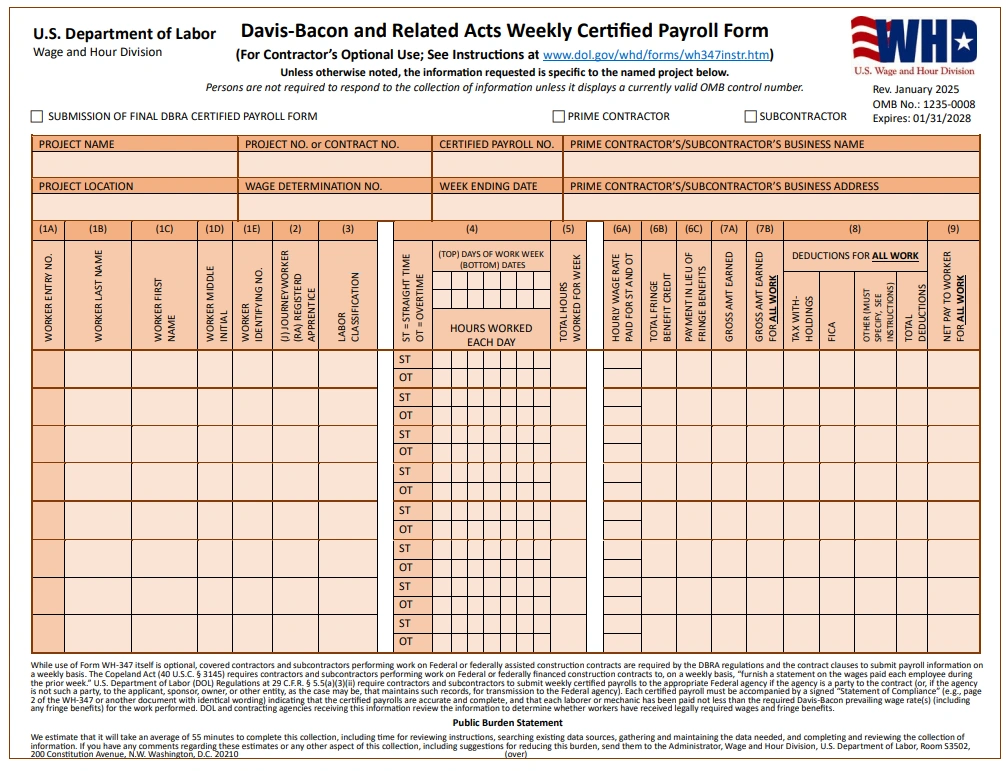
The certified payroll form wh-347 consists of two pages. Page one captures core payroll data: contractor information, payroll number, week-ending date, project details, and for each employee, their name, identification number, work classification, daily hours, and pay rates separated into base hourly rate and fringe benefits. It also includes gross wages, deductions, and net wages. Page two contains the Statement of Compliance, a legal declaration that payroll information is accurate and complete, and that each worker received no less than the required Davis-Bacon prevailing wage rates, including fringe benefits.
Completing this collection takes an average of 55 minutes. The Department of Labor and contracting agencies review this information to determine whether workers received required wages and fringe benefits. Willful falsification may subject you to civil or criminal prosecution under 18 U.S.C. § 1001 and 31 U.S.C. § 3729, as well as debarment from future federal contracts.
Step-by-Step WH-347 Form Instructions: Completing Each Section Correctly
Start with the header section. Enter your company name and complete address, then mark whether you’re the prime contractor or subcontractor. Assign a sequential payroll number starting with “1” for your first week and continue numbering consecutively. Type the word “Final” at the time you submit the last payroll for the project. Enter the project name as written in your contract, the project number from the contracting agency, complete project location, and the wage determination number. The week ending date is the last day of your pay period.
Column 1 requires you to assign each worker a sequential entry number, then record their last name, first name, and middle initial. Enter a unique identifier such as the last four digits of their Social Security Number in the worker identifying number field. Column 2 requires you to indicate whether each worker is a journeyworker (J) or registered apprentice (RA). List the labor classification as it appears in the contract wage determination. If a worker performed multiple classifications during the week, use separate lines to distinguish different job classifications and hours worked. Include hourly wages earned for each.
Complete the Statement of Compliance certifications on page two. An authorized company representative must sign this section and attest under penalty of perjury that all information is accurate. Workers must have received proper widespread wages.
Avoiding Critical Mistakes and Ensuring Error-Free Certified Payroll
Most certified payroll rejections and audit investigations stem from worker misclassification. You cannot relieve yourself of prevailing wage obligations on covered projects by classifying employees as independent contractors. Worker misclassification under the Fair Labor Standards Act creates compliance violations that extend beyond Davis-Bacon requirements. The San Francisco Office of Labor Standards Enforcement collected $1.50 million in back wages and penalties from prevailing wage enforcement alone from 2024 to 2025. The Department of Labor’s Wage and Hour Division recovered $15 million in back wages for more than 3,500 workers under Davis-Bacon violations during fiscal year 2023.
Fringe benefit underpayments represent a frequent error. Your health insurance plan costs $6 per hour, but the wage determination requires $10 per hour in fringes. You must pay the remaining $4 per hour as cash wages. Not all benefit plans qualify for fringe credit. The DOL requires bona fide benefits under legitimate written plans that a trustee or third party administers.
You must keep payroll records for at least three years on federally funded projects. Audits can surface violations from jobs completed years ago. General contractors bear responsibility for reviewing subcontractor certified payrolls before submission. Subcontractor errors expose the whole project to compliance risks. Self-correction and voluntary disclosure result in reduced penalties if you find violations before an audit begins.
Conclusion
Accurate certified payroll reporting is more than a weekly administrative task. It’s a critical part of protecting your business, maintaining cash flow, and demonstrating that your organization is prepared to deliver compliant public construction projects.
When your payroll processes are consistent, your documentation is complete, and your team understands how to properly prepare the WH-347, you’re better positioned to reduce compliance risk, avoid costly corrections, and remain audit-ready throughout every project.
Strong compliance systems create long-term advantages, from smoother project execution to greater confidence when pursuing future government-funded work.
Book a compliance consultation with Prevailing Wage Consulting to strengthen your certified payroll process, reduce compliance risk, and protect your profitability before your next public project begins.