

Davis-Bacon classification descriptions play an important role in determining how workers should be classified and paid on public works projects. But choosing the correct classification isn’t always as simple as matching an employee’s job title to a trade listed on the wage determination.
Contractors who rely on internal titles or assumptions from previous projects can make classification mistakes that lead to payroll corrections, back-wage exposure, and unnecessary pressure on project budgets. What matters is the work employees actually perform, along with the applicable wage determination and, when necessary, prevailing local area practice.
Understanding how to evaluate classifications, document field activities, and address unclear or missing trades helps contractors build more reliable payroll processes, manage labor costs, and keep projects moving.
Read and Apply Classification Descriptions
Davis-Bacon wage determinations identify the worker classifications, wage rates, and fringe benefits applicable to a project. However, they generally do not describe every task performed by each trade in detail. When the correct classification is unclear, contractors may need to consider prevailing local area practice to determine which classification covers the work. An employee’s actual work, not their title, determines the correct classification. For example, an employee may be listed as a general laborer in the company’s payroll system but spend part of the day operating construction equipment. The contractor must determine which classification on the applicable wage determination covers that work, considering local area practice when necessary, rather than automatically using the employee’s internal job title. When workers are assigned to classifications that do not reflect the work performed, contractors may face payroll corrections, back-wage liability, and additional scrutiny during compliance reviews.
Common pitfall: Treating every helper or foreman as a generic Laborer, or assuming the union or payroll title is the right classification. In reality, many trades have tightly defined scopes. For example, concrete finishing, material handling, and site cleanup may involve different classifications depending on the work performed and prevailing local area practice. Contractors should verify which listed classification covers each task rather than assuming that all related activities fall under the same trade.
Best practice: During pre-construction, review the applicable wage determination alongside the project scope and planned work activities. Identify the classifications likely to be needed and discuss any unclear tasks with field leadership. When the scope of a classification is uncertain, seek clarification through the contracting agency or appropriate DOL guidance before making assumptions. If a task is truly unique (e.g. “signal person” duties that the WD doesn’t list), raise it immediately (see Conformance below). Include classification references in your subcontractor scopes and ask superintendents to refer to them during daily planning.
When reviewing classifications, focus on the work employees will actually perform, the equipment they will operate, and how those activities relate to the classifications listed on the project wage determination. If the correct classification remains unclear, document the question and get clarification before it reaches payroll.
Document Field Work and Multi-Trade Hours
Even with the right classifications identified, mistakes happen if the field-to-payroll link is weak. If a worker does multiple jobs in a day, you must capture and report each portion under the proper classification. The WHD certified payroll instructions are clear: if a worker performed work in more than one classification, “an accurate breakdown of hours in each classification must be shown… by using a separate row for each classification”. For example, if an employee performs work covered by one classification in the morning and another classification later in the day, the contractor should document the time spent performing each type of work. When separate classifications apply, those hours must be accurately reported under the appropriate classifications and paid at the applicable rates.
Typical failure: Foremen know the details, but timecards only list one generic code. Or crews simply round every entry to a single trade. Without daily task notes, the payroll person has nothing to cross-check. The risk: you overpay (if you pay the higher-rated trade for all hours) or underpay (if you pay a lower trade when some hours belonged to a higher one).
Experienced approach: Require supervisors to note each worker’s tasks in daily reports or a simple app. Use color-coded timecards or field logs to mark when a worker switches tasks. Then ensure payroll splits the hours. According to DOL’s certified payroll instructions, when a contractor does not maintain an accurate breakdown of hours worked in different classifications, the worker must be paid for all affected hours using the highest applicable prevailing wage rate, including required fringe benefits. Accurate daily records help contractors avoid unnecessary labor costs while ensuring workers receive the correct compensation.
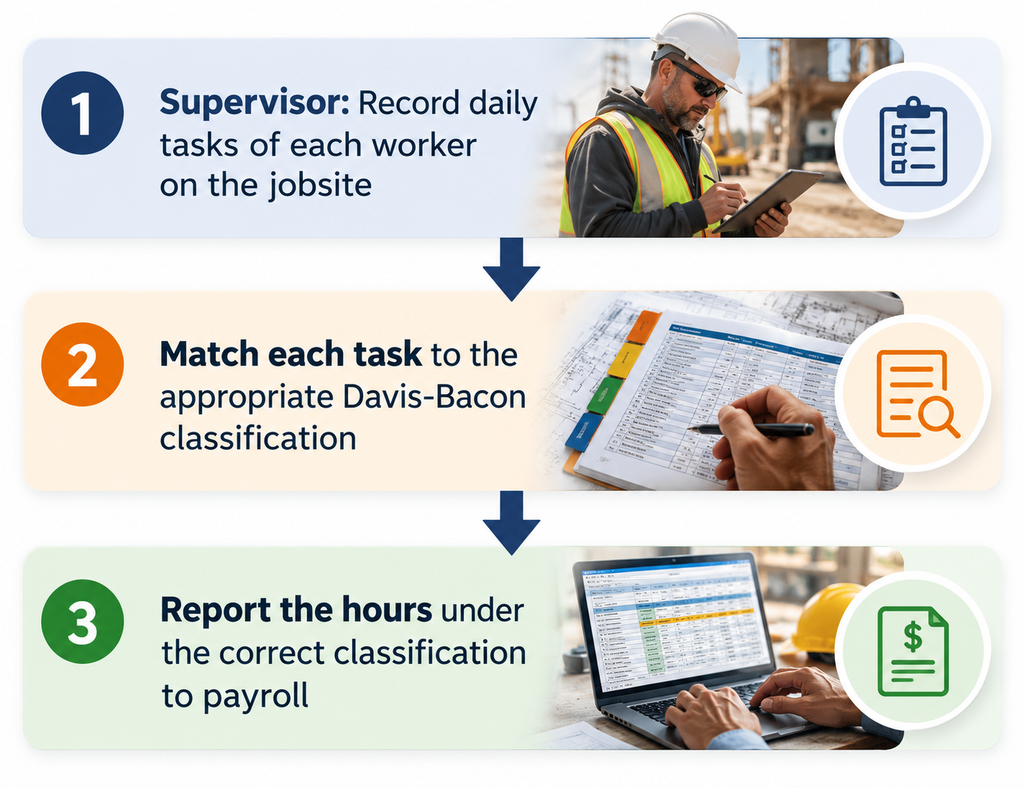
The key is making daily documentation part of the routine. When paperwork flows from foreman to payroll, each entry should connect “this worker did X task today – that falls under Classification Y.” Keeping that link saves major headaches later.
Use Conformance for Missing or New Tasks
Sometimes a project requires work that does not appear to fit neatly within the classifications listed on the applicable wage determination. Before requesting an additional classification, contractors should determine whether an existing classification already covers the work under prevailing local area practice. If the work is not covered by an existing classification and the applicable criteria are met, the formal Davis-Bacon conformance process may be required. Per FAR 22.406–3, “If any laborer or mechanic is to be employed in a classification that is not listed in the wage determination, the contracting officer… shall require that the contractor submit… Standard Form 1444…Request for Additional Classification and Wage Rate”. When conformance is necessary, contractors should coordinate with the contracting officer or responsible agency to submit the required additional classification request, typically using SF-1444, along with the proposed classification, wage rate, fringe benefits, and supporting information. For example, if a project involves specialized work and the appropriate classification is unclear, the contractor should first determine whether an existing classification covers those duties. If no listed classification covers the work, the contractor should coordinate with the contracting agency to determine whether conformance is necessary.
Common issue: Contractors often push unlisted tasks into the closest existing trade or defer action. Later, an audit can require you to reclassify all those hours and pay missing fringe benefits – a costly surprise.
Pro tip: At pre-construction or early on, scan your scope for any unusual roles. Ask the CO if those tasks fit a classification or need conformance. Identify potential classification gaps before work begins whenever possible. If conformance is necessary, initiate the request promptly through the appropriate contracting process and maintain detailed records of the work performed, hours, wages, and fringe benefits while the request is pending. Once the applicable classification and rate are determined, review all affected payroll periods and make any required adjustments, including retroactive payments when applicable.
Conclusion
Correctly classifying labor under Davis–Bacon depends on clear communication between the field and payroll. Contractors who prioritize this process protect their margins and reputations. By reading wage determinations carefully, capturing actual tasks, and acting on gaps early, you turn compliance from a liability into a managed cost. That means fewer corrections, smoother certified payrolls, and confidence that your labor costs are accurate.
Getting worker classifications right starts long before the first certified payroll is submitted. When field supervisors, payroll teams, and subcontractors understand how classification decisions are made and documented, contractors can manage labor costs with greater confidence and reduce the need for costly corrections.
Protect your project profitability and timeline by getting the classification process right from the start. Book a Prevailing Wage Strategy Session to review your project requirements, identify potential classification gaps, and establish a practical labor-compliance process before work begins.