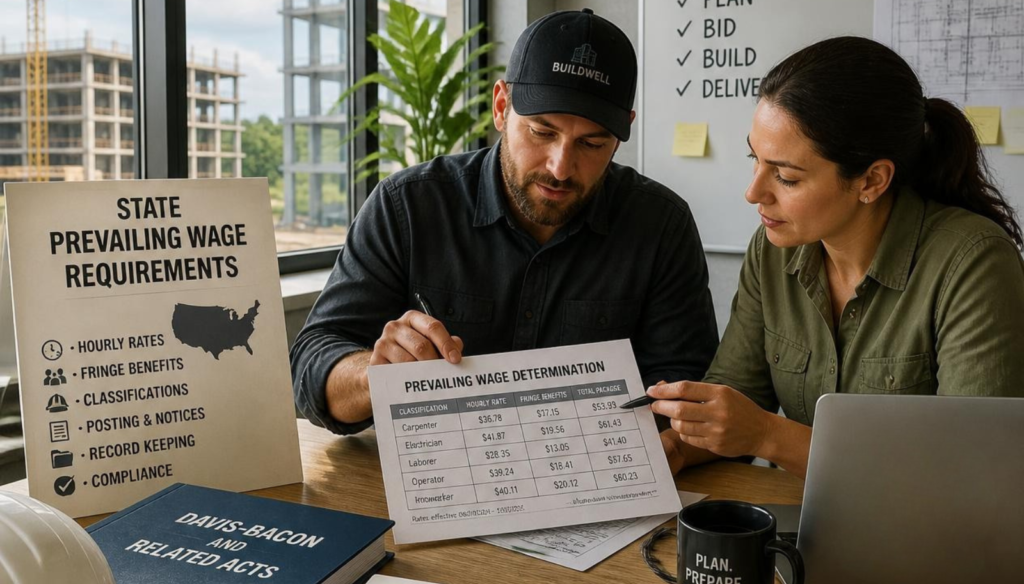
State prevailing wage requirements and state and industry-specific compliance can have a significant impact on your labor costs, bid strategy, and project profitability long before construction begins. Whether you’re bidding on infrastructure, affordable housing, renewable energy, or other publicly funded projects, prevailing wage requirements often vary by state, funding source, and project type. Assuming the rules are the same everywhere can quickly turn a profitable project into an expensive compliance challenge.
While the federal Davis-Bacon Act establishes prevailing wage requirements for many federally funded construction projects, individual states frequently adopt their own laws with different project coverage thresholds, wage determinations, certified payroll requirements, apprenticeship standards, overtime rules, registration requirements, and enforcement practices. These differences affect far more than payroll. They influence estimating, scheduling, subcontractor management, cash flow, and overall project execution.
For contractors working across state lines or expanding into new markets, prevailing wage is not simply a compliance obligation. It’s an operational system that should be built into estimating, project planning, payroll, and subcontractor oversight before a bid is ever submitted. Comparing state prevailing wage requirements early helps your team price work accurately, reduce administrative burden, avoid payment delays, and protect project margins.
Why this matters before you price the job
The biggest mistake contractors make is treating prevailing wage like downstream paperwork. In practice, state prevailing wage requirements influence your estimate from the start. They affect base wage assumptions, fringe treatment, crew mix, overtime exposure, payroll admin time, subcontractor onboarding, and the documentation you need to keep cash moving. When those items are missed at bid stage, the problem usually shows up later as margin compression, payroll rework, billing delays, or uncomfortable conversations with an owner or agency.
A simple example illustrates the point. A contractor used to weekly federal WH-347s may enter California and discover that contractors and subcontractors on most public works projects must submit certified payroll records to the Labor Commissioner using DIR’s online system, at least monthly, and that projects of $30,000 or more carry apprenticeship requirements. That is not just a forms issue. It changes staffing, admin workload, and subcontractor controls.
What contractors should compare first
Start with coverage and thresholds. Not every state triggers prevailing wage the same way. The U.S. Department of Labor’s state threshold table shows wide variation: Colorado lists a $500,000 threshold for state-funded public projects, Oregon lists no general threshold but notes major renovations are considered public works only above $50,000 and that any project using $750,000 in public funds is a public work regardless of contracting entity, while New York and Massachusetts are listed with no general threshold in that table. That means your pre-bid question cannot be “Is this public work?” in the abstract. It has to be “What funding, project type, and dollar threshold trigger this state’s law?”
Next compare wage schedules, classifications, fringe, and overtime. Federal Davis-Bacon prevailing wages include the basic hourly rate plus fringe benefits, and contractors can satisfy the obligation through cash, bona fide fringe contributions, or a combination. States often follow the same broad structure but differ in application. Oregon, for example, says workers must receive the higher of state or federal rates on nonresidential projects subject to both laws, requires the correct classification based on duties rather than title, and applies stricter overtime rules than federal Davis-Bacon on dual-covered projects. Colorado’s public-project law expressly includes regular, holiday, and overtime wages plus payments to welfare, pension, vacation, apprentice training, and education funds. Those differences affect labor-cost modeling immediately.
Then compare payroll filing and recordkeeping rules. Federal Davis-Bacon generally works on a weekly certified payroll cycle. New York now requires contractors and subcontractors on Article 8 covered work to register and electronically provide certified payroll records through the state portal every 30 days. California requires each contractor and subcontractor on most public works projects to submit certified payroll records directly to the Labor Commissioner, at least monthly, with weekly submission described as best practice. Oregon requires every contractor and subcontractor on a covered project to file certified payroll records using WH-38 information once a month, by the fifth business day of the following month. If your payroll team assumes one cadence fits all, the risk is predictable: missed filings, delayed payments, and messy catch-up work.
Also compare apprenticeship, registration, and bond requirements. California states that public works projects of $30,000 or more must meet DIR apprenticeship requirements. Colorado’s public-project law requires apprenticeship documentation for certain mechanical, electrical, and plumbing packages on qualifying non-federal public works projects of $1 million or more. Oregon requires every contractor and subcontractor working on public works projects to file a $30,000 Public Works Bond with the Construction Contractors Board before beginning work, even in some situations where the employer does not otherwise need a CCB license. New York now requires contractors and subcontractors on covered projects to register with the Department of Labor before bidding or starting work. Those are operational controls, not fine print. If your subs are not ready, your schedule is not ready either.
A practical contractor scenario
Picture a regional GC expanding from Colorado into Oregon and New York. In Colorado, the team is focused on whether the state-funded project hits the $500,000 threshold and whether any MEP packages trigger apprenticeship documentation. In Oregon, the same team now has to think about higher-of-state-or-federal rates on dual-covered work, monthly WH-38 filing, daily overtime issues, and the public works bond. In New York, the team adds contractor registration, electronic payroll every 30 days, and wage schedule updates that can be corrected monthly and paid retroactive to July 1. The work may look similar in the field, but the compliance operating model is not the same. That is why profitable contractors treat prevailing wage as a system, not a spreadsheet line.
Pre-bid checklist
Before you submit a price, confirm these items with the owner documents, awarding agency, and current state guidance:
- whether the project is covered and what threshold or funding test applies;
- which wage schedule, locality, and classifications apply;
- how fringe benefits can be credited or paid;
- what overtime rule controls if state and federal laws both apply;
- when certified payroll is due, in what format, and to whom;
- whether contractor registration, apprenticeship participation, or bonds are required for you or your subs.
Conclusion
State prevailing wage requirements are not background noise. They shape labor cost, admin burden, subcontractor readiness, and project cash flow. The contractors that handle them well do not wait for payroll to catch errors after the fact. They compare coverage, rates, filing rules, and workforce obligations before bid day, build those realities into operations, and protect margin with better control.
If you are bidding in a new state, expanding into public work, or trying to get your payroll and field teams operating from the same playbook, the next step is not more guesswork. Book a working session with PWC to identify compliance gaps, test your assumptions, and build a cleaner path to profitable execution.